


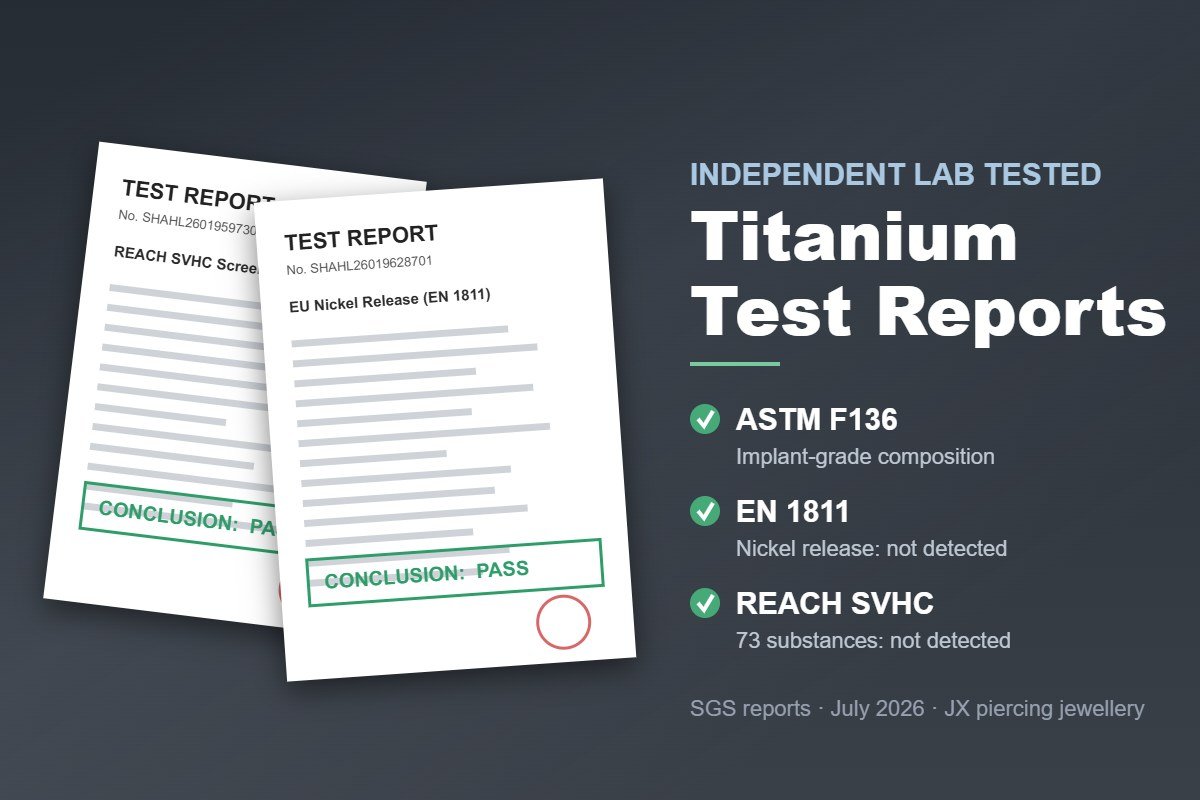
At JX, every titanium piece we sell is made for skin contact, including fresh piercings. To prove what our material really is, we sent samples of our titanium body piercing jewelry to SGS, one of the world’s leading independent testing laboratories. The samples covered our labrets, barbells, rings and studs. Below is a summary of the three reports SGS issued in July 2026.
Report 1: ASTM F136 Chemical Composition – Pass
ASTM F136 is the standard for implant-grade titanium alloy (Ti-6Al-4V ELI). This is the same material specification used for surgical implants. SGS measured each controlled element against the requirements of ASTM F136-26:
| Element | Requirement (%) | Our result (%) | Conclusion |
|---|---|---|---|
| Carbon (C) | ≤ 0.08 | 0.007 | Pass |
| Oxygen (O) | ≤ 0.13 | 0.06 | Pass |
| Nitrogen (N) | ≤ 0.05 | 0.010 | Pass |
| Hydrogen (H) | ≤ 0.012 | 0.004 | Pass |
| Aluminium (Al) | 5.5 – 6.50 | 5.92 | Pass |
| Vanadium (V) | 3.5 – 4.5 | 4.07 | Pass |
| Iron (Fe) | ≤ 0.25 | 0.025 | Pass |
All seven elements are within the ASTM F136 limits. The impurities that matter most for implant-grade titanium are carbon, oxygen, nitrogen, hydrogen and iron. All five measured well below their maximum limits.
- Report No.: SHIN2607012816ML01_EN (SGS Ref. SHHL2606041416JW)
- Issued: 7 July 2026, SGS-CSTC Standards Technical Services (Shanghai) Co., Ltd.
- Test methods: ASTM E1941, ASTM E1409, ASTM E1447, ASTM E2371
Report 2: EU REACH SVHC Screening – Pass
For customers selling in Europe, SGS also screened the same jewelry against the EU REACH Candidate List of Substances of Very High Concern (SVHC). The list was the one published by ECHA up to 4 February 2026. The screening covered 73 substances: 62 inorganic substances plus 11 organic metallic substances.
Result: no SVHC was detected. All 73 substances were below the reporting limit, and well under the 0.1% (w/w) REACH threshold. The tested sample was a titanium stud, a curved bar, a bead and a cone.
- Report No.: SHAHL26019597301 (SGS No. SHHL2606041416JW)
- Issued: 7 July 2026, SGS-CSTC Standards Technical Services (Shanghai) Co., Ltd.
- Method: SGS in-house method, ICP-OES and UV-VIS
Report 3: EU Nickel Release (EN 1811) – Pass
Nickel is the most common cause of metal allergy. EU REACH (Annex XVII, Entry 27) sets the strictest limit for jewelry inserted into pierced parts of the body: 0.2 μg/cm²/week. SGS tested a titanium stud from our range according to EN 1811:2023, running three separate trials.
| Test item | EU limit | Trial 1 | Trial 2 | Trial 3 | Conclusion |
|---|---|---|---|---|---|
| Nickel release (μg/cm²/week) | 0.2 | Not detected | Not detected | Not detected | Pass |
In all three trials, nickel release was below the method detection limit of 0.10 μg/cm²/week.
- Report No.: SHAHL26019628701 (SGS No. SHHL2606041416JW)
- Issued: 20 July 2026, SGS-CSTC Standards Technical Services (Shanghai) Co., Ltd.
- Method: EN 1811:2023, ICP-OES
What this means for you
- Implant-grade material. Our titanium meets the ASTM F136 chemical composition requirements. This is the material standard widely recommended by professional piercers for initial piercings.
- Nickel-safe. Nickel release was not detected, which is well below the EU limit for body piercing jewelry.
- Ready for the EU market. No REACH SVHC substances were detected, which makes life easier for distributors and studios in Europe.
- Independent verification. The results come from SGS, not from us.
Test results apply to the samples tested. Wholesale customers and distributors who need copies of the full reports for their own compliance files can contact us via WhatsApp or our contact page.
